14 November 1943
The Collini Case14 November 1943 is the day Fabrizio Collini’s childhood was broken by the German occupation: soldiers took his father, and a German private’s assault on his sister ended with her death in front of him. The sequence moves from an ordinary ride home across the fields to a scene of violence that a nine-year-old cannot understand, fixing the family catastrophe at the center of Collini’s past.
A Child’s Ordinary Journey
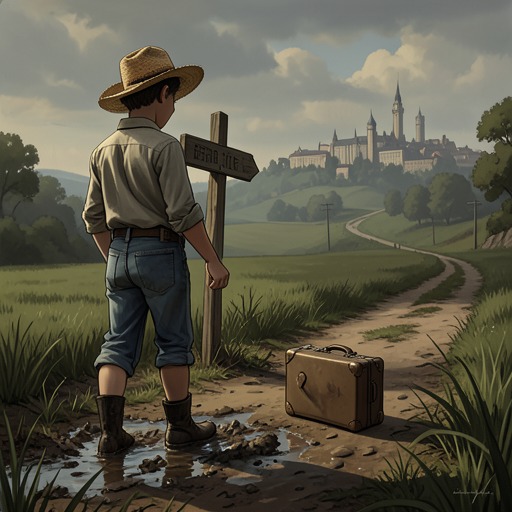
Earlier that day, Collini had attended confirmation class with eleven other children. Released by the priest, he rode his bicycle toward his father’s farm, seventeen kilometres away, eager to change out of his church suit and put on his robber outfit. The narrative introduces him through the scale of a child’s world: he ruled over one cow, four pigs, eleven chickens and two cats, and imagined himself an outstanding military commander, cycle-racing champion and circus artiste. He had already seen a crashed plane and two dead soldiers, but hunger was what mattered to him on the ride home.
The path crossed a hill between Corria and the farm. From its plateau, Collini could see the farmhouse and little barn before racing downhill. The wider landscape still looked peaceful, though the adults’ lives had already been overtaken by the war. His father sometimes left at night in a grey coat and beret; Collini’s sister had whispered that he was a partisan. Their mother had died when Collini was born, leaving the children dependent on their father and their mother’s elder brother, Uncle Mauro.
His Father Is Taken
At the farm, Collini found his sister in the doorway, still wearing her black church dress and crying. She embraced him and told him that the Germans had taken their father. The children clung to one another for a long time; Collini had questions, but his sister would not speak about what had happened. In the kitchen she mechanically fried two eggs and cut bread. Collini ate, while she left her own food untouched, and said they would go to Uncle Mauro, their only living relation, whose farm was almost ten kilometres away.
That plan ended when his sister heard a vehicle returning. She recognized the danger before Collini did and urged him to run. Through the window he saw a German military jeep, its windscreen folded down and spare tyres on the bonnet, driven by a single soldier. Collini hid in an old, empty dog kennel, curled beneath a dirty, hole-ridden blanket. Through a crack in the boards, he watched the soldier’s boots pause outside before moving toward the house.
The Shooting in the Kitchen
Collini heard his sister scream. He crawled out of hiding and ran back to the farmhouse. Inside, she lay on the kitchen table, her dress torn, while the soldier stood between her legs. He was a private, not an officer, and had a large jagged scar on his forehead. He held a cocked pistol to her breast; she was already bleeding from a wound to her forehead.
Collini screamed. Startled, the soldier stepped back, and the sights of his pistol caught in the gold chain around the girl’s neck. The chain held the gun in place as the soldier snatched at it, transferring the resistance to the trigger. The shot passed through her neck, tore an artery and lodged in the table. She clutched at her throat as blood came through her hands. The soldier fell, then sat on the floor with the pistol in his lap, staring at Collini.
The Moment That Remains
In the immediate aftermath, the child’s perception breaks into disconnected images: smoke from the shot, blood on the table, and his sister’s gold locket, a gift from their dead mother. Then he noticed his father’s brown tobacco tin on the kitchen shelf. Its lacquered lid showed two figures sitting peacefully by a campfire, unchanged amid the violence. Collini stopped screaming and stared into the soldier’s pale, watery eyes until the man moved; only then could Collini move too, and realize he had to run for his life.
The date’s force lies in the collision between ordinary childhood details and sudden, irreversible loss. The eggs, bicycle, church clothes and tobacco tin belong to a familiar family life; the father’s seizure and the sister’s death destroy its remaining security. The episode also gives Collini’s later history a concrete origin in wartime violence: he is not merely told that war is madness, but made to witness what that madness does inside his own home.